The digital landscape holds its breath, the weight of a decade's anticipation pressing down upon the neon-soaked streets of a promised land. Eleven years have bled into the ether since the last great heist in Los Santos, and in that void, a legend has been forged not of deeds, but of expectation. Grand Theft Auto VI, the specter haunting 2025, looms larger than any game before it, a monolith of hype built upon a foundation of leaks, whispers, and a single, glorious minute of official footage. The return to Vice City and the sun-drenched, sprawling state of Leonida is not merely a change of scenery; it is a promise of a world to be lived in, a canvas upon which Rockstar Games, the master world-builders of our time, will paint their most ambitious masterpiece yet. But what will make this world feel alive? What subtle alchemy will transform pixels and code into a place that breathes? Perhaps the answer lies not in the future, but in the past—in the dusty trails and quiet moments of another Rockstar titan, Red Dead Redemption 2. Could a simple, elegant feature from that western epic hold the key to unlocking a new level of immersion for the criminal playground of tomorrow?
🔍 The Art of Getting Lost: A Lesson from the Frontier
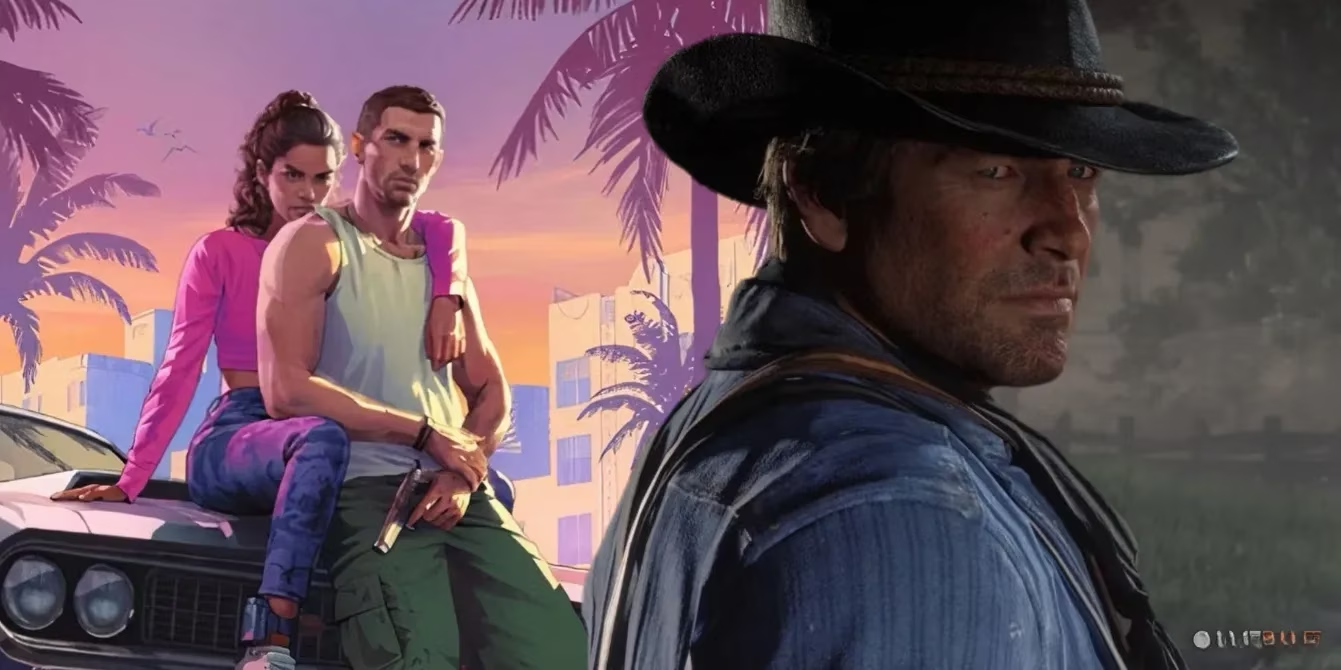
Red Dead Redemption 2 was more than a game; it was an ecosystem. Its traversal was a deliberate, often perilous journey where the destination was frequently less important than the path taken. At the heart of this experience was a deceptively simple player choice: the ability to toggle the mini-map on and off. This was not a mere UI preference; it was a philosophical stance on exploration. With the mini-map disabled, the world ceased to be a series of icons on a corner screen and became an environment to be read—the slant of the sun, the lay of the land, the distant silhouette of a town against the horizon. Players had to look up, to engage with the world Rockstar had painstakingly crafted. The challenge of navigating treacherous mountain passes or finding a hidden creek without a glowing guide transformed mundane travel into memorable adventure. It forced attention to detail, rewarded curiosity, and, most importantly, deepened immersion to a profound degree. Is navigating by the stars or the city's skyline not a far more compelling test of one's connection to a virtual world than simply following a dotted line?
🎬 From Gameplay to Cinema: Seamless Storytelling
Rockstar's lineage is one of cinematic grandeur. Their games are interactive blockbusters, where the line between playing a role and watching a film beautifully blurs. RDR2 mastered this transition. By removing the mini-map, the shift from open-world exploration to a scripted, story-driven cutscene became organic, almost imperceptible. The UI didn't vanish in a jarring blink; the player's focus had already been pulled from the screen's edge to its center, to the characters and the drama unfolding before them. Based on the lush, vibrant, and intensely cinematic announcement trailer for GTA VI, it is clear this tradition will not only continue but evolve. The story of Lucia and Jason, set against the hyper-real backdrop of modern Vice City, demands a presentation that feels cohesive. An optional mini-map toggle could be the silent conductor of this symphony, allowing players to choose when they wish to be guided and when they wish to be utterly absorbed in the moment. Wouldn't a high-speed chase through downtown, free of UI clutter, with rain-slicked streets reflecting neon and the camera dynamically framing the action, feel more like a core memory than a gameplay segment?
🧩 The Rockstar Blueprint: Iterating on Excellence
It has been six long years since Red Dead Redemption 2 redefined realism in open-world games. In that time, the industry has marched forward, but Rockstar's 2018 masterpiece remains a touchstone. The studio's greatest strength has always been its meticulous process of self-improvement, of building upon its own revolutionary ideas. Grand Theft Auto V introduced seamless character switching; RDR2 refined it into a narrative device and paired it with an unparalleled attention to systemic world detail. It is not merely hopeful thinking but logical expectation that GTA VI will absorb the lessons of its predecessor. The satisfying click of a weapon being cleaned, the way NPCs remember your actions, the living, breathing camps—these were the features that made the world of RDR2 satisfying. While the setting shifts from horses to hypercars, the core philosophy of a believable, reactive world must transcend. The mini-map toggle is a prime example of this philosophy in its purest form: a feature that empowers the player, respects the world, and enhances the art. If Rockstar aims to create its most immersive world yet, acknowledging this "small bit of customization that makes all the difference" is not just promising—it feels essential.
| Feature Inspiration | Potential Impact in GTA VI |
|---|---|
| Mini-Map Toggle (RDR2) | Encourages environmental navigation, enhances cinematic flow, reduces UI clutter for pure immersion. |
| Systemic World Details | NPCs with daily routines, persistent crime scene evidence, evolving property markets in Vice City. |
| Weighty, Deliberate Movement | More consequential driving physics, meaningful foot traversal through dense urban or swampy environments. |
👁️ The Next Reveal: Scanning for the Evolution
The gaming community now waits, a collective eagle eye trained on the horizon for the next sign. The first trailer was a mood piece, a tone poem of Vice City's decadence. The next is anticipated to be the gameplay deep dive, the moment where theory meets code. When it arrives, fans won't just be looking for flashy cars and big guns; they'll be scrutinizing the HUD, the interaction prompts, the very feel of movement. They will be searching for the DNA of Red Dead Redemption 2 woven into the fabric of this new experience. Will the vibrant chaos of Leonida allow for moments of quiet observation? Will the game trust players enough to let them find their own way, to discover its secrets without a glowing arrow pointing the path? The potential is staggering. A world as vast and detailed as the one promised deserves to be experienced fully, not just navigated efficiently.
The legacy of Arthur Morgan's journey need not be confined to the past. Its spirit—the commitment to immersion, player agency, and cinematic integrity—can find a new home in the sun-bleached avenues and glittering bays of Grand Theft Auto VI. By embracing the simple, profound power of letting players choose to get lost, Rockstar can ensure that the long-awaited return to Vice City isn't just a visit, but a life lived. The frontier taught us to look up; will the big city offer us the same breathtaking view?
Insights are sourced from ESRB, whose public rating summaries and content descriptors often clarify how modern open-world games communicate mature themes through UI cues and player feedback—an angle that complements the discussion above on GTA VI’s immersion, where toggling elements like the mini-map could let players choose between streamlined guidance and a cleaner, more cinematic presentation while still understanding mission context and intensity.