Is the gaming world truly prepared for the seismic shift that a third entry in the legendary Red Dead Redemption series would bring? As of 2026, fans remain in a state of feverish anticipation, clinging to the hope that Rockstar Games will once again grace the digital frontier with a masterpiece that redefines narrative-driven adventure. The legacy of Arthur Morgan's heart-wrenching journey and John Marston's gritty redemption looms large, setting a bar so astronomically high that one must wonder: how could Red Dead Redemption 3 possibly surpass it? The answer, it seems, may lie not in reinventing the wheel, but in perfecting one of the franchise's most iconic, yet still-evolving, mechanics: the honor system.
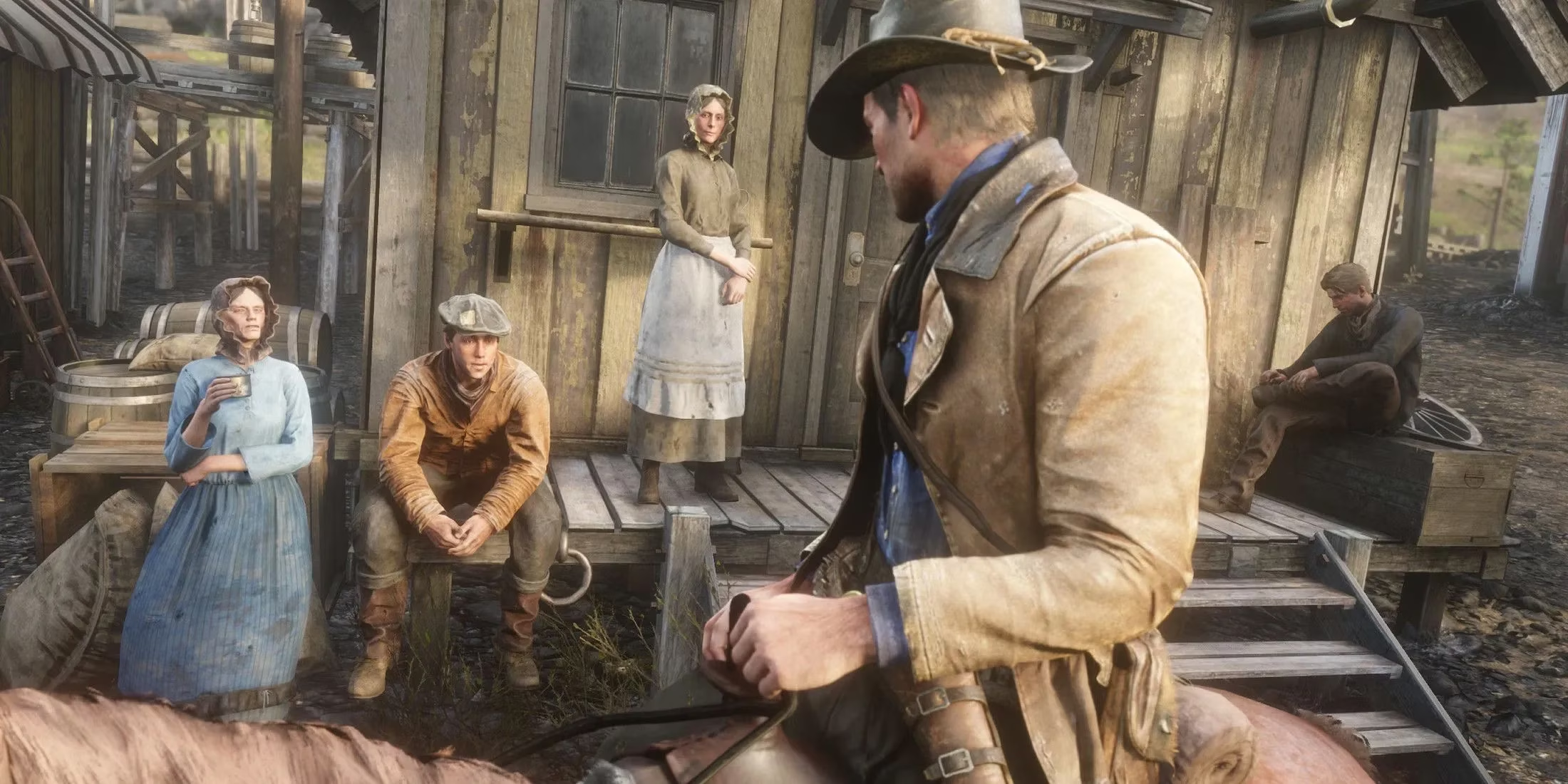
The Foundational Legacy: From Reputation to Conscience
The honor mechanic is the beating, moral heart of the Red Dead experience. Its journey began in the original Red Dead Redemption, where it functioned more as a crude gauge of John Marston's notoriety than a deep reflection of his soul. Remember the bandana? That simple piece of cloth was a get-out-of-jail-free card for morality, allowing players to commit heinous acts without a single dent to their honor score—a clear indicator that the system cared more about public perception than private virtue.
Then came Red Dead Redemption 2, a game that didn't just push the system forward; it launched it into a new stratosphere of narrative integration. Arthur Morgan's honor became an inescapable shadow, a true measure of his character that persisted whether anyone was watching or not. This was no longer just about discounts in shops; it was about the very soul of the story, dictating Arthur's final moments, the fate of his companions, and the emotional resonance of the entire epilogue. The leap was monumental, but is it the final form? Absolutely not!
The Grand Rework: Splitting the Soul of the West
For Red Dead Redemption 3, Rockstar has the potential to perform open-heart surgery on this beloved system. The key? Decoupling internal morality from external reputation. Why should these two concepts be shackled together? Imagine a dual-axis system:
| System Component | What It Measures | Potential Gameplay Impact |
|---|---|---|
| Karma / Morality | The character's internal ethical compass, their conscience. | Affects story outcomes, character visions/dreams, internal monologue, and ultimate narrative endings. |
| Reputation / Renown | How the world perceives the character, their fame or infamy. | Influences shop prices, NPC reactions, mission availability, and faction alliances. |
This bifurcation would create a tapestry of character states far more complex and realistic than a simple "good" or "bad" slider. Could you live with the consequences of being a beloved hero who is secretly rotting with guilt? Or a reviled outlaw who knows, in their heart, they fought for a just cause?
Narrative Possibilities: A Symphony of Choice and Consequence
Let's theorize the profound narrative depth this could unlock. Consider these potential character archetypes born from the new system:
-
The Guilty Paragon (Low Karma / High Reputation): The town sees a saint, but you know the blood on your hands. Story missions could involve being haunted by hallucinations of past victims, or being forced into a position of leadership that your corrupted soul feels utterly unworthy of. The climax might not be a physical showdown, but a psychological breaking point.
-
The Saintly Outlaw (High Karma / Low Reputation): Framed for a crime you didn't commit or fighting for an unpopular truth, you are hated by the very people you strive to protect. Your ending could be one of quiet, personal peace—riding into a sunset alone, content in your righteousness, even as your name is cursed in every saloon.
-
The True Monster (Low Karma / Low Reputation): The world fears you, and rightfully so.
-
The Honorable Legend (High Karma / High Reputation): The classic hero's journey, now harder than ever to achieve and infinitely more satisfying.
This system would make every robbery, every charitable act, every moment of cruelty or compassion a multi-layered decision. Helping a stranger might boost your local reputation, but if you do it for selfish reasons (like luring them into a trap later), your internal karma could plummet. Would the game be brave enough to let players navigate that dissonance?
Beyond the Binary: A Living, Reactive World
The implications for world interaction are staggering. With a separate reputation system, different regions or factions could have wildly different opinions of you. You might be a decorated lawman in Saint Denis but a wanted terrorist to the Murfree Brood. This could affect:
-
Dynamic Dialogue: NPCs wouldn't just comment on your "honor"; they'd gossip about your specific deeds and reputation in their area.
-
Faction Warfare: Playing factions against each other through careful reputation management could become a core strategic element.
-
Economic Realism: That general store discount in Valentine? That's because the shopkeeper thinks you're a fine, upstanding citizen. He has no idea about the bodies buried out by Flat Iron Lake.
The Ultimate Challenge for Rockstar
Of course, this is all glorious speculation. The minds at Rockstar are renowned for delivering the unpredictable. They might envision a system for Red Dead Redemption 3 that makes these theories look quaint. Perhaps honor will be tied to a dynamic gang loyalty system, or maybe it will become a fully non-mechanical, purely environmental storytelling device.
But one thing is certain: the discussion itself proves the boundless potential lying in wait. The honor system is the franchise's philosophical core. By evolving it from a reputation meter (RDR1) to a defining character trait (RDR2), the next logical step is to turn it into a living, breathing, contradictory embodiment of the human condition itself. Will Red Dead Redemption 3 allow us to finally explore the stark, beautiful, and terrifying space between who we are and who the world thinks we are? The frontier of interactive storytelling awaits its next pioneer. 🤠⚖️