The scent of decay hangs heavy in the air, a perfume of wet earth and secrets. I walk the sodden banks of the Kamassa River, my boots sinking into the soft, yielding mud of Lemoyne. My purpose is singular, born not from healing but from harm. I am a gatherer of quiet death, a collector of subtle venom. My quest is for Oleander Sage, the emerald jewel of the bayou, a plant whose beauty belies a heart of purest poison. In this world, survival is a knife's edge, and sometimes the edge must be coated. For crafting the tools of silent dispatch—a Deadly Poison arrow that flies true, a knife that whispers a toxic secret—this plant is indispensable. And so, I have come to its only home, the five states of the West yielding only here, in these languid, treacherous wetlands.
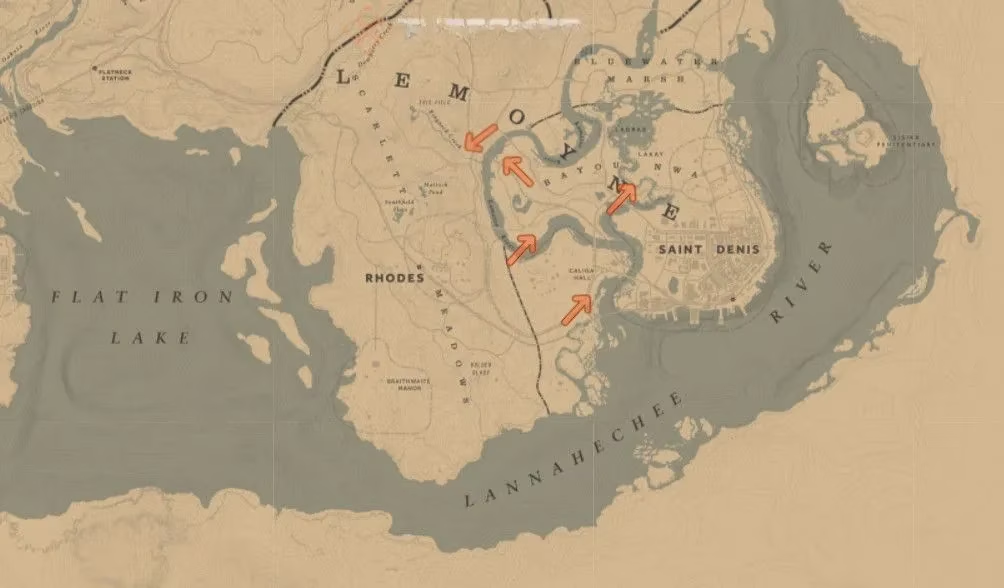
My journey, a poisoner's pilgrimage, always begins and often ends along the Kamassa River. This sluggish, brown ribbon of water is the lifeblood of the Oleander, its banks a verdant gallery of lethal potential. The air hums with insects, and the gnarled cypress trees stand as silent sentinels over my harvest.
The Reliable Patch at Calliga Hall
The first stop is one of consistency, a place I can rely on when my satchel runs dry. Across from the dock at Calliga Hall, on the northern bank of the Kamassa, a small cluster always pushes through the reeds. I kneel there, the planks of the distant dock creaking in the humidity, and pluck the slender stems with careful fingers. A single mistaken taste, a moment of carelessness, and the world would spin, my stomach would revolt—a hefty loss of health paid for a moment's folly. Further along, near the southeastern border of the same estate, where the land begins to rise towards the Lannahechee River, another scattering grows. It feels like the land itself is offering up its dark gifts.
The Isolated Clump South of Lakay
Venturing north, the atmosphere shifts. The ghostly silence of Lakay, a place of abandoned whispers, lies ahead. But south of that sad settlement, on a peninsula carved by the river's patient bend, I find solitude and more sage. Here, the growth feels wilder, untamed. The plants sprout defiantly from the damp soil, a splash of vibrant green against the muted palette of the wetlands. It is a lonely harvest, accompanied only by the cry of distant birds.
The Creek-Side Findings
Returning to the central stretch of the Kamassa, where it defines the border between the Bayou Nwa and Scarlett Meadows, the water speaks of boundaries. Just up from the mouth of Ringneck Creek, on the opposite bank, the Oleander Sage takes root again. I wade through the shallows, the cool water a relief, to claim these plants. And if I follow the water inland, continuing west past the riverside road, a final patch awaits on the north bank of Ringneck Creek itself. Here, the sage grows almost at the water's edge, as if drinking directly from the creek's flow, concentrating its potency.
This knowledge, the map of venom in my mind, is more than practical. It is poetic. Each location is a stanza in a ballad of survival. The uses are clear, a grim arithmetic:
-
Primary Function: The core ingredient for Deadly Poison.
-
Application: Coating projectiles and blades for silent, debilitating attacks.
-
Practical Need: Often required for spontaneous Daily Challenges, demanding a forager's ready knowledge.
In 2026, the need for such arts has not faded. The world remains as harsh, and the swamps of Lemoyne keep their secrets well. To walk these banks is to engage in a delicate dance with nature's darker side. I gather the Oleander Sage, its delicate leaves holding such violence, and I feel the weight of that contradiction. It is a beautiful, deadly thing, and in knowing where to find it, I hold a small piece of power over the wild, untamed heart of this land. The mud on my boots, the plants in my pouch, the silent promise of their potential—this is my craft, my solitary poetry written in poison and place.